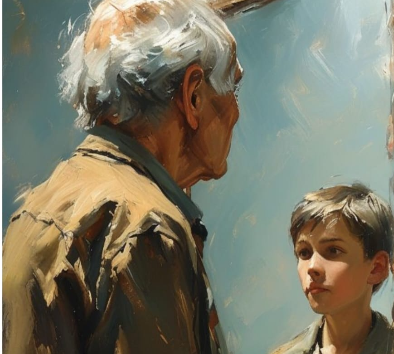
Life Standing on the Bridge of Time
I’m going to share with you all what I learned from this picture today.
Life neither stops behind nor rushes forward.
It simply stands on a bridge of time, teaching us how to walk.
On one end of this bridge lies our past—
memories, experiences, mistakes, lessons learned.
On the other end lies our future—
hopes, dreams, questions, and untold possibilities.
And between them stands our present—
this is where life truly happens.
Amer Fort

Did you know that when we look at an elderly person, we don’t just see age;
we see experience shaped by time.
When we look at a child,
we see not just innocence,
but a glimpse of tomorrow.
Life teaches us that
learning doesn’t come suddenly.
It doesn’t come as a sermon,
but rather slowly seeps into us through relationships, silence, and moments spent together.
We often think of life as a competition—
who is ahead, who is behind.

But the truth is that life isn’t a race;
it’s a continuous process.
Every age has its own time,
and every time has its own value.
This bridge of time also teaches us that
every generation is incomplete if it doesn’t understand the other.
Experience is incomplete without elders,
and the future is meaningless without children.
The most beautiful thing is that
communication on this bridge isn’t through words.
So much is said and understood through glances, silence, and standing together.
Life gives us the opportunity every day to
learn from the past,
reduce worry about the future,
and live the present with full sensitivity.

Because in the end,
life isn’t about arriving somewhere,
but about becoming human, walking the bridge of time.
Did you know that life is a continuous journey, where
one generation stands with experience
and the next with questions and hopes?
The elderly symbolize that stage of life where
learning is abundant, words are few.
A child symbolizes a stage where words are few, but curiosity and the future are vast.
The most important things in life are often conveyed without words.
Time changes, faces change, but
the need for learning, empathy, and relationships remains the same.
It reminds us that
the child today will be an old man tomorrow,
and the old man today was once learning like a child.
Therefore, life is not just about moving forward,
but also about passing on the lessons learned from the past.
“Life is a dialogue” means that life is not just a series of events,
but a continuous conversation—between us and others, between us and time, and within ourselves.

Its meaning can be understood like this:
Life asks us questions—in the form of circumstances.
We respond—through our decisions and actions.
Sometimes we speak, sometimes we say a lot by remaining silent.
This communication isn’t just through words:
Elders speak from their experience.
Children from their eyes and curiosity.
Time from their learning.
Relationships from their silence.
There are glances, postures, and silence.
There’s no preaching, yet much is being said.
That is, life teaches us that
what we hear shapes us,
and what we do in response becomes our life.
In this sense, life is speaking to us every moment—
the question is whether we are listening or not.
“Time is a bridge” means that time is a medium connecting us to different states, experiences, and generations—not just a passing moment.
Time connects the past to the present
and leads the present to the future
We change, learn, and move forward by walking on this bridge.
The elderly person represents the past—experiences, memories, lessons learned.
The child represents the future—possibilities, questions, new paths.
And the moment between them is the bridge of time.

The deeper meaning of this is:
We cannot live in the past
We cannot reach the future
But standing on this bridge of the present, we can connect both.
Time is a bridge because
We don’t have to stop on it,
but by walking on it, much can be understood and handed down.
That is, time doesn’t just take us forward;
it also gives us the opportunity to pass on the lessons learned from the past.
The saying “learning doesn’t happen suddenly” means that true understanding of life doesn’t happen in a single moment, but rather through time, experience, and constant feeling.
Understand this simply:
learning doesn’t happen suddenly like lightning.
it accumulates gradually—
from small experiences, mistakes, questions, and moments of silent observation.
A child may not understand everything in that moment.
But by standing in front of an elder, observing and feeling,
something is being recorded within, which will later become understanding.

This also means that in life:
we understand many things only when their time has passed.
And many lessons become ingrained in our behavior and thinking without being spoken.
That is, learning is not acquired by teaching, but by observing, enduring, and living.
That’s why it’s said that learning doesn’t happen suddenly—
it matures within over time, just as understanding is born from experience.
The lessons we learn in life are quiet but profound.
“Every age has its own value” means that no stage of life is inferior or useless—every age offers something special that no other can.
Childhood
→ Innocence, curiosity, openness to learning
Youth
→ Energy, dreams, the strength to struggle
Adulthood
→ Responsibility, balance, and the ability to make decisions
Old age
→ Experience, patience, and depth of life
A child is not “less intelligent”
and an elderly person is not “useless”
but both are at the best place in their respective times.
We should not be ashamed of our age
nor underestimate anyone else’s age

because
the lessons learned in childhood
cannot be lost in old age.
And the wisdom that comes in old age
doesn’t come in childhood.
That’s why every age has its own value—
and life feels complete only when we accept each stage with respect.
“Life is a continuous process, not a competition”
means that life should be understood not as a race or a competition,
but as a continuous experience.
There’s no finish line in life where everything ends.
After every milestone, a new phase begins.
So, instead of trying to outdo others, it’s more important to gradually understand and improve oneself.
Everyone’s pace is different.
Some learn early, some late.
Some struggle, some don’t.

If we think of life as a competition:
Comparison increases
Anxiety grows
And the present moment is lost.
But when we think of life as a process:
Patience develops
Acceptance develops
And every experience creates room for learning.
That is, life teaches us:
It’s not important to win quickly,
It’s important to live truly.
“Learning comes from relationships, not words” means that the deepest understanding of life comes not just from books or what someone says, but from connecting with people, experiencing their experiences, and spending time with them.

It can be understood this way:
The elder’s experience: He teaches a child much more through his presence, patience, and behavior than just “teaching.”
The child’s learning: He learns not just by listening, but by observing, understanding, and experiencing.
The power of relationships: Friends, family, teachers—those with whom we spend time have a profound impact on our thinking and understanding.
In simple terms:
Real learning in life often comes from seeing, feeling, and experiencing,
not just from listening or reading.
Note:- How did you like this information, please tell us in the comment box below. Your opinion is very important to us.
