Sometimes, doing the right thing will feel wrong —
There are times in life when we know what we are doing is morally or ideologically “right” — but it still weighs heavy on our heart, or hurts others, making us feel wrong.
This is even more complicated when:
Your decision hurts a loved one, even if it is necessary.
The right thing to do goes against social or family traditions, causing discomfort.
If your truth doesn’t match their expectations, you are seen as wrong in the eyes of others.
In fact, right and wrong are determined not just by logic, but also by emotion and context. That’s the beautiful complexity of life.
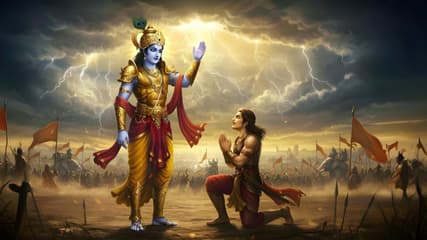
(Ask Arjuna, who fought his own blood, yet Krishna called it dharma)
Not all battles are fought for glory. Some are fought for the survival of justice. Some—like Arjuna’s—are waged within the soul, where the enemy is not hatred, but doubt.
धर्मेणैव हताः प्रेत्य धर्मो हन्ति हतः पुनः।
(“Those who destroy dharma are destroyed by it; those who uphold dharma are protected by it.”)
Standing on the battlefield of Kurukshetra, with generations of family members on both sides, Arjuna — the hero — froze.
He dropped his bow, overcome by moral conflict. Killing one’s own kin didn’t feel like righteousness.
And yet, Krishna called it dharma.
This paradox is what makes the Mahabharata not just a tale of war but a mirror to our inner conflicts. Arjuna’s dilemma is timeless —
it represents the moral discomfort we feel when the “right” path feels personally wrong. When duty demands detachment. When values test our emotions.
This is the heart of the Bhagavad Gita: not to make morality easier, but to reveal its higher purpose
1. Dharma is not about Comfort — it is about Cosmic Responsibility
The Gita does not define dharma as what feels good or emotionally right. Instead, it frames dharma as one’s role in the maintenance of universal order, where every action is connected to the larger whole.
“स्वधर्मे निधनं श्रेयः परधर्मो भयावहः॥”
(“It is better to fail in one’s own dharma than to succeed in another’s.” – BG 3.35)
Arjuna was not asked to fight because he was powerful—but because he alone was positioned to stop the collapse of justice. To abandon that duty, even with good intentions, would be to enable adharma, or the breakdown of moral order.
True dharma, therefore, is not about comfort or self-interest. It demands that we take responsibility for the greater good even when it feels overwhelming or painful. Arjuna’s reluctance to fight his own kin highlights how dharma often involves sacrifice, asking us to choose justice over personal attachment.
2. The Morality of Action is Rooted in Intention, not Outcome
Krishna teaches that action is not about the outcome, but about the intention with which it is performed. The purity of one’s heart is what determines the value of any deed.
“कर्मण्येवाधिकारस्ते मा फलेषु कदाचन।”
(“You have a right to perform your prescribed duties, but you are not entitled to the fruits of your actions.” – BG 2.47)
The moral quality of our actions comes from the selflessness behind them, not their immediate success or failure. Krishna advises Arjuna to act with detachment, without worrying about the results, because when the focus is on righteous intent, the soul aligns with cosmic law.
This teaching reveals a universal truth: Right action, regardless of its outcomes, has an eternal impact. When we choose to act for the greater good, without concern for personal gain, we align with dharma and transcend individual desires.
3. Clarity of Purpose Comes through Detachment
Detachment is a powerful force in the Gita’s teachings. It is not about renouncing the world, but about liberating the mind from the shackles of emotion, desire, and personal attachment. This detachment gives clarity to see truth without distortion.
“यत्साङ्ख्यैः प्राप्यते स्थानं तद्योगैरपि गम्यते।”
(“The state which is attained by knowledge is also reached through detached action.” – BG 5.5)
When we detach ourselves from the expectations of the world, we gain the freedom to see clearly, without being clouded by personal biases or attachments. Arjuna was reminded to rise above his familial attachments and to view the war not as a personal tragedy, but as a cosmic necessity.
Detachment allows us to see what must be done, even if it doesn’t feel comfortable or emotionally correct. Dharma, in this context, is about acting from a place of higher understanding, where personal loss and sacrifice are not seen as failures but as part of a greater divine plan.
4. Emotion Must Be Felt, but Not Allowed to Rule
Krishna does not dismiss Arjuna’s grief; he acknowledges it, but he also teaches that grief should
not control actions.
Emotions are part of the human experience, but they must not dictate our decisions when it comes to fulfilling dharma.
“शोच्यानन्वश्चोषस्त्वं प्रज्ञावादांश्च भाषसे।”
(“You grieve for those who should not be grieved for, yet speak words of wisdom.” – BG 2.11)
The Gita teaches that while emotions like fear, grief, and desire are part of our experience, they should not blind us to the greater truth. Arjuna’s grief for his family was real, but Krishna pointed out that dwelling on those emotions would only hinder his ability to act in accordance with dharma.
Emotions are guides, not rulers. The ultimate wisdom lies in seeing beyond immediate emotional reactions to the higher purpose that needs fulfillment.
5. Right Action Often Demands Inner Sacrifice
The path of dharma is not easy—it often involves inner sacrifice, where we release personal desires for the sake of a higher moral duty. Arjuna’s conflict was rooted in his love for his family and his fear of destroying what he held dear. But Krishna urged him to transcend these attachments in favor of the greater good.
“तस्मादसक्तः सततं कार्यं कर्म समाचर।”
(“Therefore, always perform your duty without attachment.” – BG 3.19)
Dharma demands that we go beyond our comfort zones. Self-interest, no matter how noble, is secondary to fulfilling one’s role in the universe.
This sacrifice may be as simple as choosing truth over convenience or as complex as giving up relationships or desires that conflict with righteousness. It’s not about abandoning the world but about understanding its impermanence and acting with wisdom in the moment.
6. True Courage is Facing What Feels Wrong — in Service of What is Right.
Arjuna’s inner struggle was profound, as he was asked to do something that felt deeply wrong: to fight his own kin. But Krishna asked him to see beyond that and to fight for the greater good—the preservation of righteousness.
“न त्वेवाहं जातु नासं न त्वं नेमे जनाधिपाः।”
(“Never was there a time when I did not exist, nor you, nor these kings.” – BG 2.12)
Courage does not lie in avoiding discomfort, but in confronting it. True courage is the ability to stand for righteousness, even when it demands difficult sacrifices.
The right action, though painful, often requires us to face what feels unjust or wrong in our own eyes. However, it is only through facing these inner conflicts that we can truly fulfill our dharma.
7. Dharma is a Mirror, Not a Weapon
Dharma is not meant to be used to judge others; it is a personal compass, guiding us towards truth. Krishna never forced Arjuna’s hand—he only showed him his duty and asked him to choose wisely.
“विमृश्यैतदशेषेण यथेच्छसि तथा कुरु।”
(“Reflect on this fully, and then do as you wish.” – BG 18.63)
The Gita emphasizes free will—Arjuna was not forced into battle. Instead, he was shown the path of righteousness and left to choose. Dharma, when understood correctly, is not a tool for judgment or coercion; it is a reflection of our highest self, guiding us toward actions that are aligned with truth and virtue.
Dharma Begins Where Comfort Ends
To stand in dharma is to often stand alone—not because you are wrong, but because you are choosing truth over sentiment. Arjuna’s inner war is the same one we fight when we must speak up against injustice in family, challenge corruption in society, or walk away from what no longer serves growth.
The Gita does not glorify blind duty—it glorifies conscious action rooted in timeless wisdom. It asks us to move from the small self to the higher self. From attachment to awareness.
“नाहं कर्ता सर्वस्य हरिः कर्ता”
(“I am not the doer; Hari (the divine) is the doer of all actions.”)
When we understand this, we realize:
Doing the right thing will feel wrong only until you remember who you truly are.
Note- Sometimes, doing the right thing also seems wrong? What is your opinion about this, please tell us in the comment box below. Your opinion is very important to us.