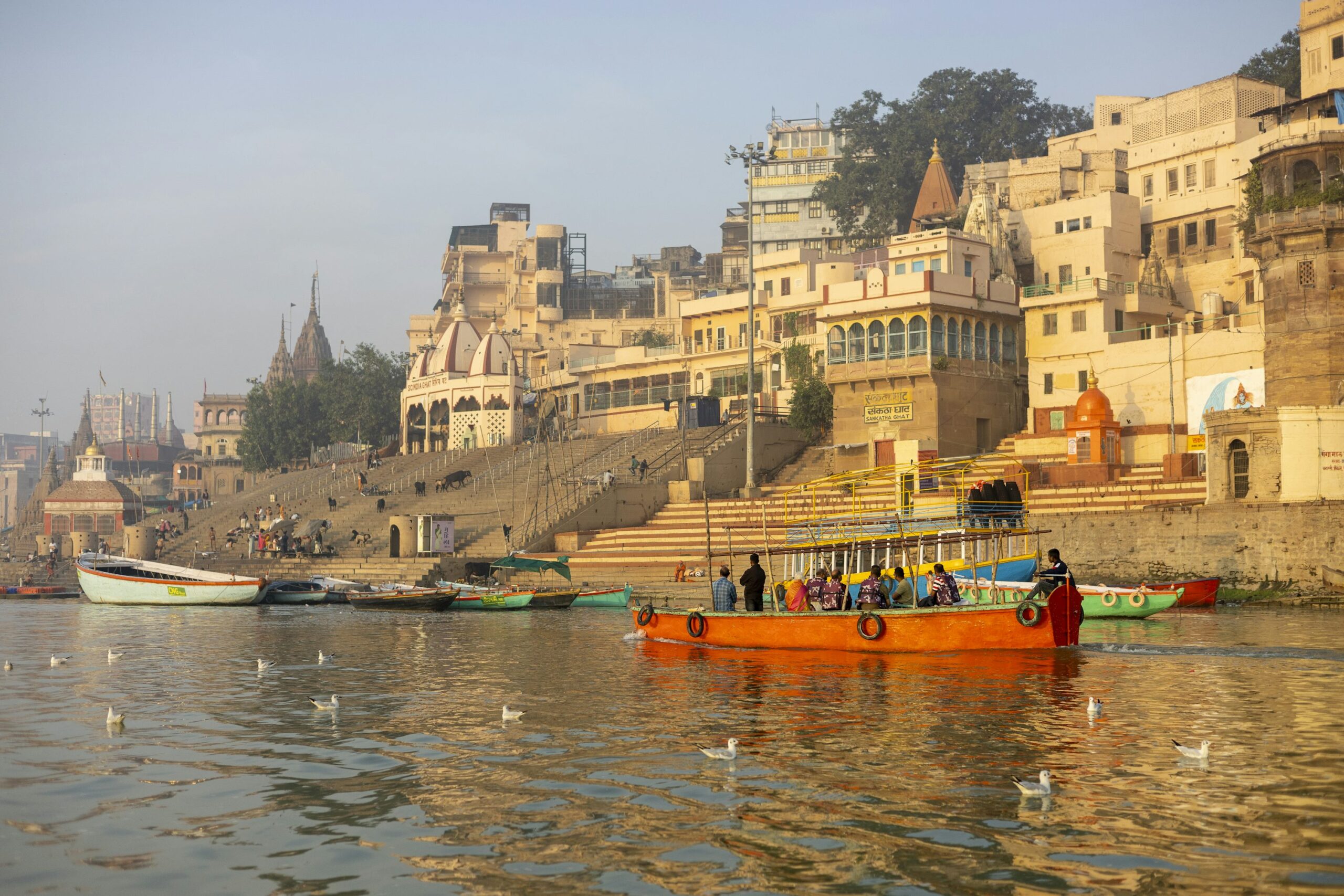
Where Time Stands Still – A Journey Through the Ghats of Varanasi
Banaras, also known as Varanasi or Kashi, is an ancient and historic city in India. Located on the banks of the Ganges River in the state of Uttar Pradesh, it is considered a sacred place for Hinduism, Buddhism, and Jainism. It is one of the oldest continuously inhabited cities in the world.
Banaras – a city that holds the entire story of life, death, and salvation within its ghats. A visit here is not merely a tourist experience, but a journey of the soul. Ghats along the Ganges, such as Dashashwamedh, Manikarnika, and Assi, witness the stories of thousands of devotees, seekers, and travelers every day.
Banaras: The City of Ghats
Banaras, also known as Kashi or Varanasi, is India’s most ancient and sacred city, situated on the banks of the Ganges River. Over 80 ghats, located along the Ganges River, shape the city’s religious, cultural, and historical identity.
Banaras (Varanasi) is not just a city, but a living book of stories. Every street, every temple, and every ghat holds a historical and spiritual tale. Let’s explore the story of one such historic site in Banaras – the Kashi Vishwanath Temple.
Banaras (Varanasi) is one of the world’s most ancient and sacred cities, and millions of people visit it every year to experience its spirituality, culture, and ghats.
In 2023, over 10 million people visited Banaras, with a large number attending the Kashi Vishwanath Dham Corridor, Ganga Aarti, and cultural experiences.

Indonesia A Journey to the Ancient Hindu-Buddhist Culture
Who comes?
Pilgrims from all corners of India
Foreign tourists from countries like Europe, America, Japan, and Thailand
Saints, yoga enthusiasts, and students
Photographers, bloggers, and documentary makers
Historical Features of Banaras:
Religious Significance:
Banaras is known as the “city of salvation.” It is believed that dying here leads to liberation (moksha).
The Kashi Vishwanath Temple is located here, one of the twelve Jyotirlingas of Lord Shiva.
Tulsidas composed the Ramcharitmanas here.
The Ganges River and Ghats:
The ghats of Banaras, especially the Dashashwamedh Ghat, are famous throughout the country.
The Ganga Aarti is a magnificent sight, attracting thousands of devotees and tourists daily.
Relations to Buddhism:
Sarnath is located near Banaras, where Gautam Buddha gave his first sermon.
Center for Education and Culture:
Banaras Hindu University (BHU) is a leading educational institution in India.
The city has also been a great center of music, art, and literature – figures such as Pandit Ravi Shankar and Ustad Bismillah Khan were associated with it.
Handicrafts and Banarasi Sarees:
Banarasi saris are world-famous for their intricate zari work and silk.
Banaras is not just a city, but a spiritual and cultural heritage. The soul of India resides in its streets, temples, ghats, and people. It is a place where life, death, and salvation coexist.
Banaras – The Story of a Historical City
Long ago, when time itself was perhaps not as organized as it is today. Then, on the banks of the Ganges, there existed a city – Kashi, which we know today as Banaras or Varanasi. It is said that Lord Shiva himself founded this city. It was not a center of the earth, but of spirituality. It is said that here time stands still and the soul finds peace.

Jaisalmer Fort (also known as Sonar Qila or Golden Fort)
Beginning of the Story
Once, Brahma, Vishnu, and Shiva were discussing which was the most sacred place in the world. Brahma said, “My Pushkar!” Vishnu replied, “My Badrinath!” But Shiva smiled and said, “My Kashi!” Where salvation itself awaits.
Lord Shiva established Kashi on his trident so that it would never waver. Since then, the city has been known as the “Eternal City.” Years passed, kings came and went, and times changed, but Varanasi remained steadfast—like a sage immersed in meditation.
Land of Saints and Sadhus
Saints like Kabir, poets like Tulsidas, and social reformers like Ravidas—all were born or settled here. Tulsidas wrote the Ramcharitmanas here, Kabir awakened society with his couplets, and Ravidas showed the path of devotion. Devotion echoes in every street of Banaras.
Stories of the Ghats
The ghats along the Ganges, such as Dashashwamedh Ghat, Manikarnika Ghat, and Assi Ghat, tell thousands of stories every day—of birth, death, love, and penance. Manikarnika Ghat, in particular, is where people breathe their last in the hope of salvation.
It is said that the fire never extinguishes at Manikarnika Ghat. Life does not end here; a journey is completed, and the soul finds a new direction.
The Soul of Banaras
Banaras is not just a city of bricks and stones. Mornings here begin with aarti, and evenings again with aarti. Music hangs in the air, and a wave of classical music can be heard at every turn.
Banaras’s Banarasi saris, paan, elegance, and the spirit of its people—all combine to make this city a vibrant entity.
The Essence of the Story
Banaras is a city where history breathes in every street, where spirituality peeks from every wall, and where life and death coexist on the same ghat.
It is not just a city, it is a feeling—an experience that cannot be expressed in words, but can only be lived.
The Story of the Kashi Vishwanath Temple
(Banaras’s most sacred and historic site)

Book Your Trip Now
The Story Begins:
Long ago, the gods were discussing—there was no place on Earth where Lord Shiva himself resided. Then Shiva chose a place—where the Ganges flowed, where the lamp of righteousness burned—and there he established Kashi.
Shiva founded Kashi:
Shiva said, “Whoever dies in my city, Kashi, I will grant salvation myself.”
That is why Kashi is called the “City of Salvation.”
Kashi Vishwanath Temple:
This temple is one of the twelve Jyotirlingas of Lord Shiva.
Here, Shiva is worshipped as “Vishwanath” – the Lord of the entire universe.
It is said that when Mughal ruler Aurangzeb destroyed this temple, Maharani Ahilyabai Holkar (18th century) rebuilt it. Later, Maharaja Ranjit Singh plated the temple’s spire with gold – a mark that still shines today.
Land of Miracles:
Devotees who visit here believe that all the wishes of anyone who visits Kashi Vishwanath with a true heart are fulfilled.
It is also said that after death, Lord Shiva whispers the “Moksha Mantra” into the ear, freeing the soul from bondage.
Another Historical Place – Manikarnika Ghat
Book Your Trip Now
It also has a story:
It is said that once, Goddess Parvati’s earring fell while bathing in the Ganges. Shiva excavated the spot, creating the Manikarnika Ghat.
This ghat is considered a prominent place for cremation, and it is believed that the funeral pyre fire never goes out. This is why this ghat has become a symbol of salvation.
The Kashi Vishwanath Temple and Manikarnika Ghat are the soul of Banaras.
These places are not just temples or ghats, but bear witness to thousands of years of culture, faith, and spirituality.
When you visit Banaras, don’t just see these places – feel them, because behind every brick, every lamp, and every bell lies a historical story.
Each ghat has its own story, tradition, and speciality.
The Importance of the Ganga River and Ghats
The Ganga River is revered as Mother Ganga in Hinduism.
In Banaras, the Ganges flows northward, called “Uttarvahini Ganga” – this is considered very auspicious.

History of cellular jail true story
The ghats here:
Famous for bathing, worship, meditation, and rituals.
Each ghat has a mythological tale or history behind it.
List of major ghats and their stories
1. Manikarnika Ghat
This is the most ancient and sacred ghat.
Funerals are performed here.
It is believed that death leads to salvation here.
It is said that Goddess Parvati’s earring fell here, giving it the name Manikarnika.
2. Dashashwamedh Ghat
This ghat is the most famous and vibrant ghat in Varanasi.
The Ganga Aarti held here every evening is a spectacular sight.
It is said that Lord Brahma performed ten Ashwamedha Yagyas here – hence the name Dashashwamedh.
3. Assi Ghat
This ghat is the place where the Assi River joins the Ganga.
Literary figures, musicians, and saints engage in meditation and spiritual practice here.
The intellectual and cultural soul of Banaras is linked to this ghat.
4. Panchganga Ghat
It is believed that five sacred rivers (Ganga, Yamuna, Saraswati, Kirana, and Dhutpapa) meet here.
This place has been a center of religious texts and scholars.
5. Tulsi Ghat
This ghat is associated with Goswami Tulsidas.
He composed the Ramcharitmanas here.
Even today, Ramlila is held here.

Ganga Aarti: The Soul of the Ghats
A grand Ganga Aarti is held every evening at Dashashwamedh Ghat and Assi Ghat.
The rows of lamps, the sound of bells, and the devotional atmosphere—the experience is unforgettable.
The Spiritual Impact of the Ghats
The ghats of Banaras are not just stone steps; they are centers of spiritual energy.
Coming here, a person:
connects with themselves,
understands life and death together,
and experiences peace.
Conclusion:
The ghats of Banaras are India’s spiritual heritage.
These ghats are not just pilgrimage sites, but living symbols of culture, history, and faith.
Like the flow of the Ganges, the ghats of Banaras teach us the depth and simplicity of life.
Note:- Where Time Stands Still – A Journey Through the Ghats of Varanasi.? Please tell us in the comment box below. Your opinion is very important to us.
2 thoughts on “Where Time Stands Still – A Journey Through the Ghats of Varanasi”